
The latest results from the National Assessment of Educational Progress (NAEP) painted a sobering picture of student learning across the nation.
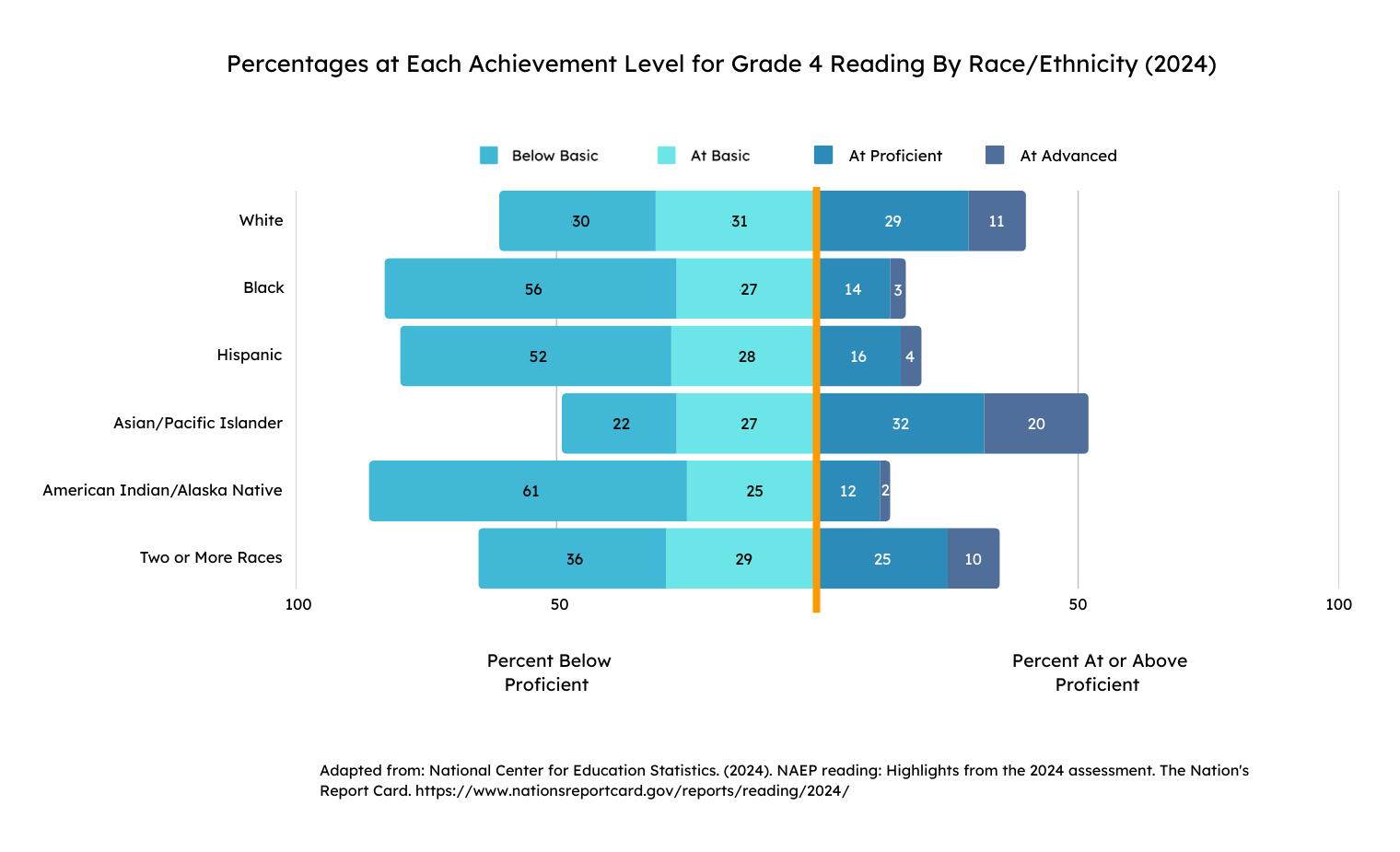
Just 31% of fourth graders performed at or above proficiency in reading, a 2 percentage point drop from the last test administration. When disaggregated by race and ethnicity, the results are even more sobering: just 14% of Black students; 16% of Hispanic students; and 12% of American Indian/Alaskan Native students performed at or above proficiency (NAEP, 2024).
And yet, beneath the headlines, we see hope.
We are seeing encouraging evidence that sustained, system-wide commitment to the science of reading can yield meaningful results. States like Louisiana, Mississippi, and Tennessee, which have maintained their focus on implementing research-based instructional approaches and materials, are now seeing growth in their NAEP scores. Their success reinforces what we have long believed: while system change takes time and commitment, it is an investment that pays dividends in student achievement. For all students.
At Lit, we wanted to hear directly from education leaders about how they are approaching literacy in their systems. We surveyed a group of twenty leaders from school systems large and small to understand their priorities, challenges, and where they see the greatest need for support. (More than half worked in districts; 40% worked in public charter schools.)
In a series of blog posts, we’re breaking down what we heard. Here’s part one.
Literacy Is a Universal Priority—But Why?
Every single leader we surveyed confirmed that literacy is a priority in their system. When asked why, half described literacy as the foundation for all other subjects.
“Literacy is the backbone to all successful learning.”
“Reading makes everything else possible.”
Others framed their focus on literacy in terms of student outcomes:
“We currently have less than 50% of students reading on grade level across grades K-8. We have made it our top priority this year in an effort to close the gap.”
In particular, leaders talked about the impact of pandemic learning loss and years of stagnate (or declining) reading proficiency on their oldest students. As one leader wrote, “Our students are struggling through multiple years of poor reading instruction. They have coping mechanisms that often mask the foundational issues that are now blocking their comprehension and ability to nimbly comprehend grade-level text.”
Recent NAEP scores underline these challenges. Students in the lowest percentiles saw their lowest reading scores in three decades in both fourth grade and eighth grade, declining more sharply than their peers at higher percentiles (NAEP, 2024).
We also heard that some systems’ priorities are being driven by state mandates and a growing understanding of the science of reading.
Where Are They Focused?
At Lit, we define all the components that support reading instruction across a district as the “reading ecosystem.” Our Reading Ecosystem Alignment Diagnostic (READ) distills decades of research about reading, reading instruction, and instructional leadership into a set of indicators of an aligned, research-based reading ecosystem. (See more about the reading ecosystem in this guide.)

We asked leaders to name which elements of a strong reading ecosystem were in place in their system today.
The most common responses:
- Expertise in the “science of reading” and evidence-based reading instruction
- High-quality instructional materials
- An assessment suite that addresses all components of skilled reading
We weren’t surprised to see HQIMs high on this list. Research has shown that High-Quality Instructional Materials can have a statistically significant impact on student learning (Chingos & Whitehurst, 2012)), particularly for the least experienced teachers (Jackson & Makarin, 2016). (You can read more in a recent article in the Journal of the National Association of State Boards of Education linked here.) In our conversations with schools and districts, curriculum, assessments, and teacher professional learning are often top of mind. It’s why we often address these first as part of the first “gateway” of our work with systems.
Lasting change, however, requires wider investment in the systems, structures, and routines that bring those design elements to life every day in a system even as staff change and student needs shift. We’ll talk more about what leaders would most like to improve in their system in our next post.
Sources:
Chingos, M. M., & Whitehurst, G. J. “Russ.” (2012). Choosing Blindly: Instructional Materials, Teacher Effectiveness, and the Common Core. https://www.brookings.edu/wp-content/uploads/2016/06/0410_curriculum_chingos_whitehurst.pdf
Jackson, K., & Makarin, A. (2016, July). Simplifying teaching: A field experiment with “off-the-shelf” Lessons (WP-16-11): Institute for Policy Research – Northwestern University. Simplifying Teaching: A Field Experiment with “Off-the-Shelf” Lessons (WP-16-11): Institute for Policy Research – Northwestern University. https://www.ipr.northwestern.edu/our-work/working-papers/2016/WP-16-11.html
National Center for Education Statistics. (2024). NAEP reading: Highlights from the 2024 assessment. The Nation’s Report Card. https://www.nationsreportcard.gov/reports/reading/2024/